•  
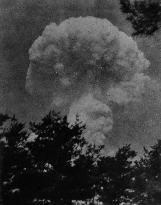
Mushroom cloud (A few minutes after detonation)

Mushroom cloud (A few minutes after detonation)

Mushroom cloud captured a few minutes after the detonation of the atomic bomb; taken about 6.5 kilometers northeast of the hypocenter. According to records held by the United States Armed Forces, the cloud billowed to 9,000 meters in the sky within three minutes of the blast. The photograph was taken by Seiso Yamada, then 17, who was walking to visit Mikumari Gorge in Fuchu-cho, Aki County in Hiroshima Prefecture, with his friends. They were watching a B-29 and a parachute in the sky from the entrance to the gorge when a flash, a rumbling of the ground, and a roar suddenly hit them. Trees in the pine forest around them shook violently from the blast, and a huge mushroom cloud rose rapidly, which he photographed with a Japan-made camera he had brought with him. (The parachute Mr. Yamada saw is believed to have been the blast measurement instrumentation dropped by one of the planes accompanying the Enola Gay.) **Editorial use only, Commercial use not possible**, Credit: Seiso Yamada/Chugoku Shimbun/Kyodo News Images

  •  
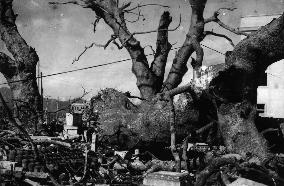
A-BOMBED-CAMPHOR TREE

A-BOMBED-CAMPHOR TREE

Camphor tree taken after the bombing, September 1945, Photo: Yoshito Matsushige, Collection:Photo Archives of Japan, Ownership: Chugoku Shimbun, **Editorial use only, commercial use not possible**, Credit: Chugoku Shimbun/Kyodo News Images

  •  
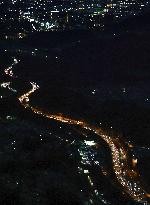
Return rush of New Year holidaymakers in Japan

Return rush of New Year holidaymakers in Japan

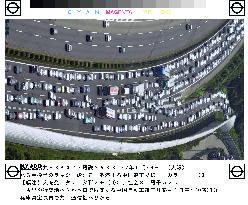
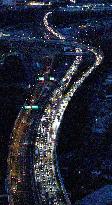
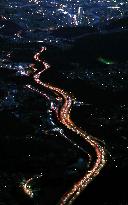
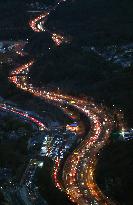
Photo taken from a Kyodo News helicopter shows Osaka-bound lanes on the Chugoku Expressway packed with cars in Nishinomiya, Hyogo Prefecture, on Jan. 4, 2025, as the New Year's holiday season nears its end.

  •  
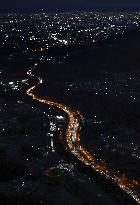
Return rush of New Year holidaymakers in Japan

Return rush of New Year holidaymakers in Japan

Photo taken from a Kyodo News helicopter shows Osaka-bound lanes on the Chugoku Expressway packed with cars in Nishinomiya, Hyogo Prefecture, on Jan. 4, 2025, as the New Year's holiday season nears its end.

  •  
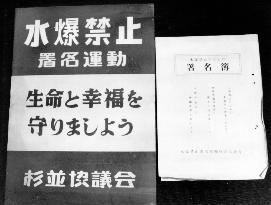
Lists of signatures and a poster, made by the Suginami Council

Lists of signatures and a poster, made by the Suginami Council

Keyword: Lists of signature, poster, the Suginami Council, a ban on hydrogen bombs=circa1980, location unknown, Credit: Chugoku Shimbun/Kyodo News Images

  •  
John Hersey and Kyoshi Tanimoto in Hiroshima, 1985

John Hersey and Kyoshi Tanimoto in Hiroshima, 1985

Keywords: John Hersey, Kyoshi Tanimoto,Hiroshima, Hiroshima Nagarekawa Methodist Church=Date:1985, Place: Hiroshima, Japan, Credit: Chugoku Shimbun/Kyodo News Images

  •  

Japan: Cars Drive Through Smoke-Filled Tunnel After Fire On Expressway

A car fire erupted inside a tunnel on Sanyo Expressway in Yamaguchi Prefecture, western Japan on Saturday, August 10 filing the tunnel with smoke and shutting down the highway for both directions for hours. There was heavy traffic on the highway at the the time as it was the first day of Bon holidays. No injuries were reported.

  •  
Wrecked Hiroshima Prefectural Industrial Promotion Hall (now the A-bomb Dome) and Aioi Bridge

Wrecked Hiroshima Prefectural Industrial Promotion Hall (now the A-bomb Dome) and Aioi Bridge

The wrecked Hiroshima Prefectural Industrial Promotion Hall (right) and Aioi Bridge (left), which was the target of the atomic bomb. The wreckage of Japanese Red Cross Society Hiroshima Branch's building can be seen between the Industrial Promotion Hall and the bridge. The ruined Industrial Promotion Hall became known as the “A-bomb Dome" after the war. Yoshito Matsushige, who took this photograph, recalled, "I think it was the first. (Distance from hypocenter 150meters) Photo taken in September 1945, by Yoshito Matsushige, Chugoku Shimbun. **Editorial use only, Commercial use not possible**, Credit: Chugoku Shimbun/Kyodo News Images

  •  
Barbershop with the window frame blown off

Barbershop with the window frame blown off

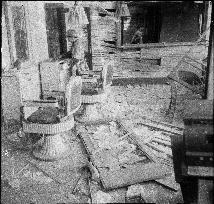
A barbershop in Midori-machi (now Nishimidori-machi in Minami Ward) destroyed by the blast, with the window frame blown off and the interior, including mirrors, shattered. It was the home-cum-shop of Yoshito Matsushige, a photographer who took this picture. The barbershop was run by his younger sister and her husband, and Sumie, Matsushige's then 29-year-old wife, who appears in the scene, helped them with the business. Sumie was pregnant at the time and gave birth to their second daughter the following year. His eldest daughter and parents were evacuated to Omishima Island in Ehime Prefecture at the time. (Distance from hypocenter 2800 meters.) Photo: Yoshito Matsushige, Collection: Photo Archives of Japan, Ownership: Chugoku Shimbun, **Editorial use only, commercial use not possible**,Credit: Chugoku Shimbun/Kyodo News Images

  •  
Police officer writing out victim certificates

Police officer writing out victim certificates

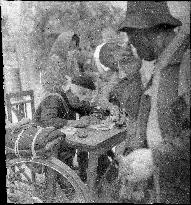
Tokuo Fujita, then 28, a police officer from the Ujina Police Station, surrounded by victims, is writing out victim certificates for survivors in front of the Hiroshima District Monopoly Bureau, located on the east side of Miyuki Bridge. The desk was placed on the south side of the "Minami-machi 3-chome" streetcar stop (now called "Minami-machi 6-chome"). Mr. Fujita, who had just finished working the night shift, experienced the atomic bombing at the police station about 4.7 kilometers from the hypocenter. His forehead was cut by broken window glass, but he rushed to the police box on the west side of Miyuki Bridge and helped injured citizens and students. (Distance from hypocenter 2400 meters.) Photo: Yoshito Matsushige, Collection: Photo Archives of Japan, Ownership: Chugoku Shimbun, **Editorial use only, commercial use not possible**,Credit: Chugoku Shimbun/Kyodo News Images

  •  
Central part of the city reduced to ashes as seen from Kyobashi Bridge

Central part of the city reduced to ashes as seen from Kyobashi Bridge

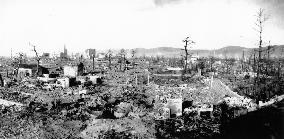
The central part of the city reduced to ashes as seen from Kyobashi Bridge (1.4 kilometers northeast of the hypocenter) on the southwest side of the Hiroshima Station. The building with a tower on the far left is the head office of the Chugoku Shimbun, on its right is Fukuya Department Store, and the structure behind the tree in the center right is Hiroshima Central Broadcasting. Three photographs taken from the railings of Kyobashi Bridge over the Kyobashi River were stitched together for this picture. (Distance from hypocenter 1400 meters.) Photo taken in November 1945, by Yoshito Matsushige, Chugoku Shimbun. **Editorial use only, Commercial use not possible**, Credit: Chugoku Shimbun/Kyodo News Images

  •  
Devastation at the west end of Miyuki Bridge (Panoramic view)

Devastation at the west end of Miyuki Bridge (Panoramic view)

At the west end of Miyuki Bridge, 2.2 kilometers southeast of the hypocenter. A police officer from the Ujina Police Station had begun to administer first aid by applying oil stored in the station to the wounds of the injured men and women of all ages who had taken refuge there. Men and women collapsed or squatting, a woman holding a baby, female students receiving first aid, and a police officer are captured in the photo. The railings on the lower river side (left side) of the bridge had been blown into the river. The building on the left is the Senda-machi Police Box of the Ujina Police Station, and the building in the back is Hiroshima Technical Institute. Miyuki Bridge, connecting Senda-machi and Minami-machi, is one of the major bridges in Hiroshima City, on which streetcars also run. (Distance from hypocenter 2200 meters.) Photo: Yoshito Matsushige, Collection: Photo Archives of Japan, Ownership: Chugoku Shimbun, **Editorial use only, commercial use not possible**,Credit: Chugoku Shimbun/Kyodo News Images

  •  
Devastation at the west end of Miyuki Bridge (Close-up)

Devastation at the west end of Miyuki Bridge (Close-up)

People suffering burns received dabs of transformer oil brought from the nearby Hiroshima Electric Railway. The girl in the foreground, wearing a sailorstyle uniform with a triangular collar, and the girl to her left were second-year students at Hiroshima Girls' Commercial School (then 13 years old) who experienced the atomic bombing at the Hiroshima Postal Savings Bureau in Senda-machi 1-chome, where they were mobilized to work, but survived. The boy second to the right of the police officer from the Ujina Police Station was a first-year student at Hiroshima Municipal Junior High School (then 12 years old) who experienced the atomic bombing in Koami-cho (now part of Naka Ward), where he was helping to demolish buildings to create fire lanes. It is believed he was on his way to his home in Danbarasuehiro-cho (now Danbara in Minami Ward), where he lived with his parents. He went missing and his remains were never found. (Distance from hypocenter 2200 meters.) Photo: Yoshito Matsushige, Collection: Photo Archives of Japan, Ownership: Chugoku Shimbun, **Editorial use only, commercial use not possible**,Credit: Chugoku Shimbun/Kyodo News Images

  •  
Collapsed Minami Branch of Nishi Fire Station

Collapsed Minami Branch of Nishi Fire Station

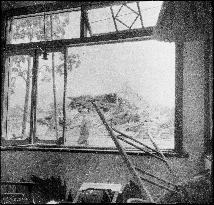
The view from the destroyed window of the home-cum-barbershop looking east. The Minami Branch of the Nishi Fire Station, a two-story wooden structure, collapsed in the blast and was reduced to rubble. A man in a national defense uniform walks toward Miyuki Bridge along the street on which ran the Ujina Line streetcars. (Distance from hypocenter 2800 meters.) Photo: Yoshito Matsushige, Collection: Photo Archives of Japan, Ownership: Chugoku Shimbun, **Editorial use only, commercial use not possible**,Credit: Chugoku Shimbun/Kyodo News Images

  •  
Rush of travelers returning from New Year holidays

Rush of travelers returning from New Year holidays

OSAKA, Japan - Photo taken from a Kyodo News helicopter on Jan. 2, 2012, shows the Chugoku Expressway jammed with vehicles in Kobe, Hyogo Prefecture. The rush of travelers returning to the Tokyo metropolitan region from New Year holidays in their hometowns or other travel destinations began the same day, jamming trains, flights and expressways across Japan.

  •  
Holidaymakers' return rush begins

Holidaymakers' return rush begins

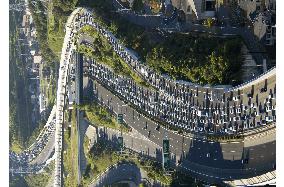
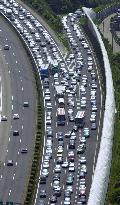
NISHINOMIYA, Japan - The Chugoku Expressway in Nishinomiya, Hyogo Prefecture, is flooded Aug. 14 with holidaymaker's cars returning to major cities from the annual ''Bon'' midsummer holidays in Japan.

  •  
Vacationers jam highways

Vacationers jam highways

TAKARAZUKA, Japan - The Chugoku Expressway is jammed with vehicles in Takarazuka, Hyogo Prefecture on May 3, the first of four consecutive holidays.

  •  
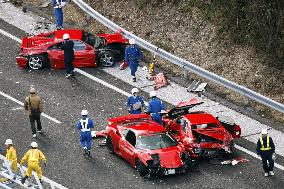
Luxury cars wrecked in expressway pileup

Luxury cars wrecked in expressway pileup

Photo take from a Kyodo News helicopter shows three Ferrari cars wrecked in a multi-vehicle accident on the Chugoku Expressway in Shimonoseki, Yamaguchi Prefecture, western Japan, on Dec. 4, 2014. (Kyodo) ==Kyodo

  •  
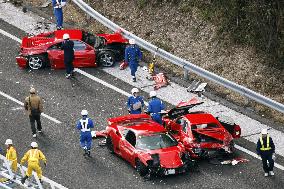
Luxury cars wrecked in expressway pileup

Luxury cars wrecked in expressway pileup

Photo take from a Kyodo News helicopter shows three Ferrari cars wrecked in a multi-vehicle accident on the Chugoku Expressway in Shimonoseki, Yamaguchi Prefecture, western Japan, on Dec. 4, 2011. (Kyodo) ==Kyodo

  •  
Travelers return from year-end, New Year holidays

Travelers return from year-end, New Year holidays

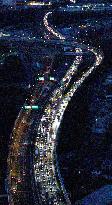
Photo taken from a Kyodo News helicopter shows a traffic jam on the Osaka-bound lane of the Chugoku Expressway on Jan. 3, 2016, as people headed home after spending their year-end and New Year holidays in their hometowns. (Kyodo) ==Kyodo

  •  
Holidaymakers' return rush begins

Holidaymakers' return rush begins

NISHINOMIYA, Japan - The Chugoku Expressway in Nishinomiya, Hyogo Prefecture, is flooded Aug. 14 with holidaymaker's cars returning to major cities from the annual ''Bon'' midsummer holidays in Japan. (Kyodo)

  •  
Rush of travelers returning from New Year holidays

Rush of travelers returning from New Year holidays

OSAKA, Japan - Photo taken from a Kyodo News helicopter on Jan. 2, 2012, shows the Chugoku Expressway jammed with vehicles in Kobe, Hyogo Prefecture. The rush of travelers returning to the Tokyo metropolitan region from New Year holidays in their hometowns or other travel destinations began the same day, jamming trains, flights and expressways across Japan. (Kyodo)

  •  
New Year holidays come to end

New Year holidays come to end

Photo taken from a Kyodo News helicopter shows traffic congestion on the Osaka-bound lane of the Chugoku Expressway on Jan. 3, 2018, as travelers head back to the city at the end of the New Year holidays. (Kyodo) ==Kyodo

  •  
New Year holidays come to end

New Year holidays come to end

Photo taken from a Kyodo News helicopter shows traffic congestion on the Osaka-bound lane of the Chugoku Expressway on Jan. 3, 2018, as travelers head back to the city at the end of the New Year holidays. (Kyodo) ==Kyodo

  •  
Vacationers jam highways

Vacationers jam highways

TAKARAZUKA, Japan - The Chugoku Expressway is jammed with vehicles in Takarazuka, Hyogo Prefecture on May 3, the first of four consecutive holidays.

  • Main
  • Top
  • Editorial
  • Creative
  • About Us
  • About ILG
  • Terms of use
  • Company
  • BEHIND
  • Price List
  • Single Plan
  • Monthly Plan
  • Services
  • Shooting
  • Rights Clearance
  • Support
  • FAQ
  • How To Buy
  • Contact Us
  • Become a Partner

© KYODO NEWS IMAGES INC

All Rights Reserved.

  • Editorial
  • Olympics
  • News
  • Sports
  • Japan
  • Tech
  • Royal
  • Disaster
  • NorthKorea
  • Old Japan
  • SNS
  • Creative
  • Food
  • Japan
  • Landscape
  • Animal
  • Popular
  • #Ukraine
  • #Thailand
  • #coronavirus
  • #N. Korea
  • #China
  • #Russia
  • #Ukraine
  • #Thailand
  • #coronavirus
  • #N. Korea
  • #China
  • #Russia
  • Food
  • Japan
  • Landscape
  • Animal
  • Olympics
  • News
  • Sports
  • Japan
  • Tech
  • Royal
  • Disaster
  • NorthKorea
  • Old Japan
  • SNS